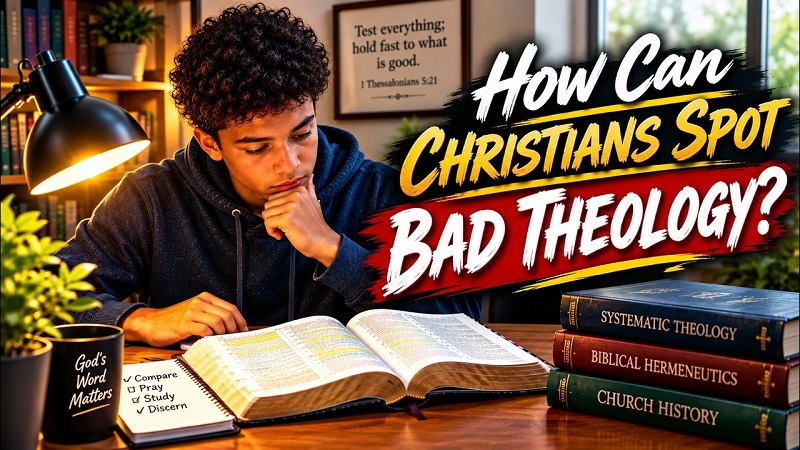
How Can Christians Spot Bad Theology?
Besides misunderstanding the role and purpose of theology, many Christians struggle to distinguish between the Bible and theology. As a result, it becomes difficult to recognize when a theology is undermining the faith. Let’s examine six approaches to spotting weak theologies that might jeopardize the faith of believers in various ways.
The Theology is Crafted to Defend a School of Thought
To keep it simple, a school of thought is the engine of every theology. It influences the way theology handles the Scriptures and directs the course of the interpretation that follows. Each worldview has its own school of thought that allows it to interpret the Bible. For example, Calvinists interpret the Bible believing that God exercises His absolute sovereignty through His grace rather than free will. Armenians believe that humans possess free will and can choose to accept or reject God. These two groups never reach a consensus. Other Christian groups approach the Bible with the perspective that Jesus is not God, or is simply a prophet or an ordinary human being. Others deny the trinity, opting for their preferred theory and reading the Bible through their unique lens. For anyone wanting an accurate interpretation of Scriptures, the sole guidance to depend on is the Holy Spirit. The Bible depicts Him as the sole guide to all truths (John 16:13).
The Theology Begins with an Assumption then Looks for Verses to Validate it
Assuming things or forming suggestions and theories in life is perfectly fine as long as we conduct sincere research. The sole purpose of assuming something or creating a theory should be to conduct research aimed at uncovering the truth. The research findings have the potential to validate or invalidate your thought. Here is where the difficulty usually occurs, since many engage in research to validate their theory or assumption at any cost, despite insufficient evidence. The appropriate response upon assuming something is to carry out sincere scientific investigation and concede when evidence is insufficient. Individuals who consider their viewpoint infallible and avoid critical evaluation are entirely mistaken. They are often the ones who create problematic theologies with contradictory interpretations of the Bible.
The Theology Relies on Selected Scriptures, not on the Entire Bible
A major issue in Bible interpretation within the Body of Christ today is depending on selected Scriptures to construct theologies for Bible doctrines. This is evident in various areas like marriage, tithing, sowing financial seeds, prosperity, healing, women ordained to lead men, the trinity, and more. Many randomly select Bible verses from both covenants, neglect to interpret them within their context, and construct theologies that inadequately explain the doctrines they aim to clarify. A lot of imbalances arise from this, as many prioritize their own desires and go their separate ways, neglecting the Bible’s calls for unity.
A major reason Calvinism and Arminianism will never agree is their reliance on selected Scriptures. We must not casually dismiss God’s sovereignty, nor assume that God created us as robots with no ability to make decisions. God’s sovereignty and free will operate side by side, a mystery we struggle to clarify. But He made things that way to ensure we remain humble. We can conduct a similar analysis for all the other aforementioned areas of misinterpretation. Christians who base their theologies on selected Scriptures seldom let the Bible interpret itself, unless it supports their preconceived beliefs.
The Theology Wants to Maintain Certain Christian Traditions
There is nothing wrong with having unique Christian customs and approaches to worship and service. God structured the Christian faith to ensure His gifts to us manifest in a variety of ways. Nevertheless, we need to be cautious in differentiating human traditions from God’s doctrines. Many Christians perceive their denominational loyalty through a traditional lens, believing it to be more scriptural than other denominations. The question emerges whether God is responsible for creating denominations with conflicting doctrines. Clearly, our different geographical locations and cultural backgrounds will lead to varied forms of worship and service. Nonetheless, these human and geographical diversities should not conflict with God’s doctrines. It is alarming when people mix cultural, geographical, and traditional alienations with the doctrines of the Bible. These kinds of actions always cause confusion since people focus more on their traditions and human patterns than on the Word of God. A major issue with such tendencies is that they result in extreme religiosity.
The Theology Doesn’t Distinguish Between the Old and New Covenants
We briefly mentioned this earlier by noting that the Bible has two covenants, and a Christian who fails to differentiate between them will face limitations in their spiritual journey. The Word of God in the Old Testament paves the way for us to understand the New. To genuinely understand the New Testament, we must first carefully analyze the Old. Although the Old Testament is considered obsolete, it is presented as a copy or subordinate version of the New, with many principles and doctrines repeated within the New. Undoubtedly, the New Testament can be confirmed as having a much greater standard than the Old. Not differentiating between the Old and New Covenants when interpreting the Bible inevitably results in misunderstanding and misinterpretation.
The Theology Doesn’t Point to Christ and Him Crucified
Theology that doesn’t center on glorifying Christ is pointless. Throughout the Bible, from Genesis through Revelation, there is a unique message that directs attention to Christ. Our theologies should concentrate on research efforts that improve our understanding of that message. When theology emphasizes wealth and worldly achievements without Christ directing it for His purposes, it becomes nonsense. We are here on earth with one mission: to know God through Christ, by the Holy Spirit’s help, and to lead a holy life in obedience to His Word by carrying out His will. Hence, we can look forward to living forever with Him at His return, since we are merely temporary in this fading and corrupt world that holds no hope for the lost. Anything that doesn’t follow this line of thought is a waste of time on earth.
Don’t forget to share this message with anyone grappling with the relationship between the Bible and theology.
Delve into study, research, and meditation on the Word, increase in wisdom, and remain blessed in the Lord!