Is God the Author of All Christian Worldviews and Theological Camps?


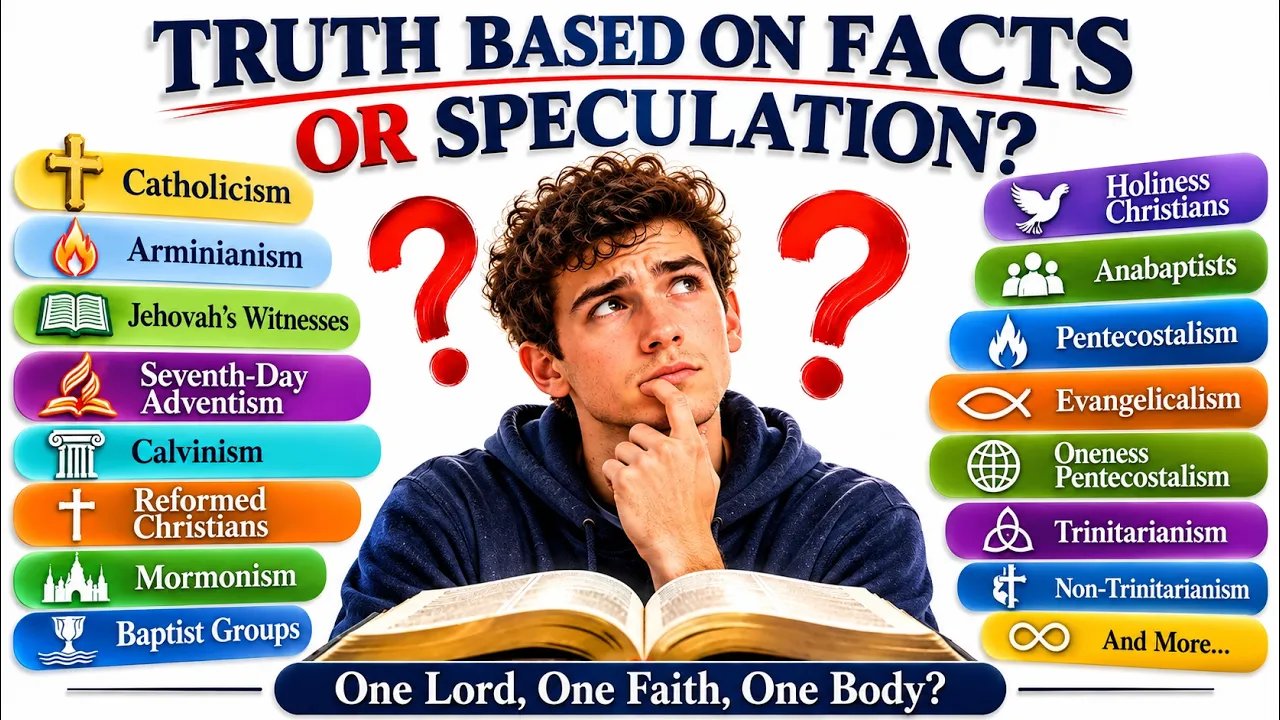
The Christian world contains numerous worldviews, theological systems, and denominations. From Calvinism and Arminianism to Catholicism, Pentecostalism, and many others, Christians often find themselves separated into different camps. This raises an important question: Is God the Author of all these Christian worldviews and theological camps?


To answer this question, we must first understand what a worldview is, what a denomination is, and what the Bible teaches about unity and diversity within the Body of Christ.


Worldviews and Denominations


A denomination is a distinct religious group that shares a general faith but has its own beliefs, practices, or organizational structure (Wikipedia). Examples include Catholics, Baptists, Anglicans, Presbyterians, Lutherans, Methodists, Adventists, and many others.


A worldview is the fundamental cognitive lens, framework, or set of beliefs through which an individual, group, or society interprets reality, makes sense of life, and guides their actions (truthstory.org).


Within the Christian faith, there are many worldviews and theological schools of thought, including Calvinism, Preterist, Jehovah’s Witnesses, Mormonism, Arminianism, Protestantism, Orthodoxy, Pentecostalism, Evangelicalism, Trinitarianism, Non-Trinitarianism, Fundamentalism, and more.


Unity and Diversity


The Bible presents a clear relationship between unity and diversity. A people or group are united when they have the same doctrines, laws, regulations, principles, and interpret them the same way. Christians are united when they understand and interpret God’s doctrines (the Bible) in the same way.


People in a united community exercise their gifts and talents in different or diverse ways. Diversity, therefore, relates to gifts, talents, and competences. People serve differently because the Holy Spirit gives different gifts to different individuals.


In 1 Corinthians 12, Paul speaks of “diversities of gifts,” “diversities of ministries,” and “diversities of activities.” Yet there is still the same Spirit, the same Lord, and the same God. The diversity is found in the types of giftings, ministries, and activities, not in interpretation of the Logos.


God’s design for the Church is therefore a community that is united in regulations, rules, doctrines, and principles, but diverse in gifts, talents, competencies, and service.


So, Is God the Author of All Christian Worldviews and Theological Camps?


When we examine the many Christian worldviews and denominations around us, one fact becomes difficult to ignore. They do not all believe the same things. They do not all interpret doctrine the same way. They do not all move in the same direction.


Many hold conflicting and even contradictory positions. Some trust authorities or writings that compete with Scripture itself. The result is a landscape of competing interpretations, theological disputes, and confusion among sincere seekers of truth.


This is not to say that the Christian faith lacks answers. Truth exists, and God guides His people through the Holy Spirit. However, the reality remains that the Christian world is divided by conflicting worldviews, denominational systems, and theological camps. For this reason, the answer to our question is no.


God is not the author of confusion. The conflicting and contradictory nature of many worldviews and theological camps points not to God’s design but to human ideologies, intellectual pride, and theological systems that have become entrenched in their own positions.


How Should Christians Move Forward?


First, Christians must remember that they are Christians before they are anything else. The Bible speaks of one body, one faith, one baptism, and one Lord Jesus Christ. (Ephesians 4:1-7). No denomination or worldview is greater than the Body of Christ itself.


Second, believers must rely on the Holy Spirit. Jesus promised that the Holy Spirit would guide His people to the truth (John 16:13). Christians should therefore seek His guidance above human labels, traditions, and theological camps.


Finally, believers should focus on growing in faith, wisdom, and knowledge of God’s Word while allowing the Holy Spirit to direct their lives. Although denominations and worldviews may be difficult to avoid entirely, they should never replace devotion to Christ or obedience to His Word.


Conclusion


The Bible presents a picture of a Church that is united in doctrines while diverse in gifts and ministries. Today’s conflicting worldviews and theological divisions fall short of that ideal. Therefore, God cannot be regarded as the Author of all Christian worldviews and theological camps.


Our ultimate loyalty must not be to a denomination, a theological system, or a religious label. It must be to Jesus Christ, His Word, and the guidance of the Holy Spirit. By keeping Christ at the centre, Christians can avoid confusion and sincerely grow in the faith wherever God wants them to be.


If you found this article helpful, consider sharing it with others in your community. Meaningful discussions about faith issues like this can encourage unity, enhance genuine research in the Body of Christ, and help believers grow in wisdom, faith, and spiritual maturity.


Stay Blessed in the Lord!



Can Christian Factions Disagree About Theology and Remain United?

This is one of those questions that seldom enters our minds as we engage in different Christian activities within conflicting Christian movements. This question is particularly important because God builds a unified Christian movement called the Body of Christ, and demands that we dedicate considerable spiritual resources to maintain that Body’s unity and vitality. To respond to this question properly, we need to explore some important facts about genuine Christians that many overlook.


All True Christians Belong to a Single Movement – The Body of Christ

Contrary to the common belief that everyone who calls themselves Christian shares the same identity, true Christians form one organization called the Body of Christ. In Ephesians 4:1-6, the Bible states, “I, therefore, the prisoner of the Lord, beseech you to walk worthy of the calling with which you were called, with all lowliness and gentleness, with longsuffering, bearing with one another in love, endeavoring to keep the unity of the Spirit in the bond of peace. There is one body and one Spirit, just as you were called in one hope of your calling; one Lord, one faith, one baptism; one God and Father of all, who is above all, and through all, and in you all.” It is plainly obvious that anyone not acknowledged by God as part of this united body is not a true Christian. In light of this reality, labeling ourselves or identifying with any denominational affiliation is less important than meeting the obligations of belonging to that group. Sadly, many individuals caught in different Christian religious cycles feel compelled to defend their belief system instead of focusing on doing God’s will in their context. As a result, numerous so-called Christian organizations worldwide adhere to and promote conflicting doctrines, preventing unified progress.


All Genuine Christians are of the Same Mind

Genuine Christians belong not only to one body but also share spiritual unity with each other. Naturally, this is not obvious when observing the current chaos within the divided Christian groups we have formed. Attending a Catholic Church service will never leave you feeling the same as leaving a Pentecostal service. You also won’t have the same feelings and beliefs when you attend a Methodist, Charismatic, and Oneness Pentecostal fellowship. These movements not only exhibit diverse forms of worship but also contain conflicts within their core doctrines and schools of thought. As a result, leaders in these Christian groups hold their own unique agendas and interpretations of God’s message for the world. The encouraging news is that despite the chaos, God preserves a remnant that discerns and obeys His will, despite suffering under biased and subjective ideas and patterns in their system. God reaches out to sincere inquirers everywhere in the world, including among Buddhists, Muslims, atheists, pagans, and even scientists who deeply seek the truth but are unsure how to find it. By His mercy, He always finds a way to reveal Himself to these people and lead them to a community of true Christians who will help them develop spiritually.


The imperfection of human systems stems from our fallen state, yet this should not be used as a reason to pursue self-centered goals, as many theologians suggest. A few Christian denominations possess a real and concentrated manifestation of the Holy Spirit within their community. Others experience only a superficial presence of the Holy Spirit, influenced mainly by human theological methods and traditions that lean more towards religiosity than authentic worship of God. Of such the Bible describes as, “having a form of godliness but denying its power.” Moreover, the Bible sternly warns, “And from such people turn away!” (2 Timothy 3:5). Most modern Christian groups are loosely formed assemblies guided by their own desires, with clear examples including inclusive, progressive, socialist, cults, occult, and new age Christian communities.


If genuine Christians were brought together from their various contexts to a single location, they would easily participate in any type of fellowship, like worship or prayer, something the current self-centered movements cannot achieve. This is because the Holy Spirit directs all genuine believers and inspires no kind of self-centeredness, contradiction, or conflicting ideologies among them. The Bible captures this in Revelation 7:9-10, “After these things I looked, and behold, a great multitude which no one could number, of all nations, tribes, peoples, and tongues, standing before the throne and before the Lamb, clothed with white robes, with palm branches in their hands, and crying out with a loud voice, saying, “Salvation belongs to our God who sits on the throne, and to the Lamb!”


Genuine Christians are not Many

Following Jesus’ teachings in Matthew 7:13-23, we see that throughout the whole church era, only a small portion of the world’s population is truly Christian. This is plainly obvious from today’s materialistic and selfish trends worldwide. Believing the common statistics on search engines that claim genuine Christians number in the billions would be a fatal mistake. These statistics overlook the Bible’s focus on genuine repentance and a life of obedience to God as key criteria. If you’re reading this article, you should aim to be one of the few chosen from the many who are called.


Answer

“Can two walk together, unless they agreed?” (Amos 3:3). “If a kingdom is divided against itself, that kingdom cannot stand” (Mark 3:24). Based on what we’ve observed, Christian factions differ in their beliefs, disagree on theology, don’t share the same core doctrines for their spiritual journey, and aren’t always guided by the Holy Spirit. Because they differ on these core matters that define the authentic Christian movement, they are not united. For sincere inquirers, it is more beneficial to identify as a Christian rather than seek denominational affiliations. Since most true believers belong to various Christian denominations, your principal goal should be to follow God’s will wherever you are. Nonetheless, you are responsible for verifying that you belong to a fellowship with a genuine emphasis on the Holy Spirit and whose activities are inspired and led by Him.

Share this message with individuals in your community who find it challenging to understand the relationship between the Bible and theology.

Study, explore, gain wisdom, and remain blessed in the Lord!


Why do we Have so Many Christian Worldviews and Denominations?

When you consider how many groups label themselves as Christian, you can be tricked into thinking they all truly are for Jesus. Sadly, many of these groups merely profess a Christian identity with no concrete substance about Christ. Many of these movements oppose one another, despite not having openly acknowledged their rivalry. In this piece, we focus on investigating the reasons for the numerous Christian movements and worldviews.


Many Christians Rely on Poorly Developed Theologies

When the meaning, purpose, and goal of theology in a Christian’s life and the entire Christian community are misunderstood, inevitably, we will base theological development on the incorrect school of thought. Ultimately, the generated theologies will not properly embody God’s will and will completely misguide our Christian journey away from His purpose. All of this leads to confusion, disunity, disagreements, and intellectual pride. This is precisely what we observe among Christians, with their numerous conflicting theologies resulting in countless Christian positions, beliefs, and perspectives all claiming to represent Jesus. The Bible, however, teaches there is one God, one church, one Holy Spirit, one faith, and we should be of one mind (Ephesians 4:1-6, 1 Corinthians 1:13, Romans 12:16, Romans 15:5, 1 Corinthians 1:10, 2 Corinthians 13:11, Philippians 2:2, 1 Peter 3:8). Our present chaos and intellectual arrogance do not fit neatly within God’s design and purpose. The fact that God works through many of us in these chaotic and conflicting movements does not mean He is satisfied with or approves of our present condition.

Many Christians Have Selfish Agendas

What leads some Christian movements to separate from the rest? What thoughts occupy the minds of Christians who choose to follow their own path without seeking joint or collaborative efforts to find the truth? It’s obvious that their agenda does not sufficiently match the gospel of Jesus Christ. If your message doesn’t convey Christ crucified and total commitment to Him, it’s essentially worthless. Sadly, many groups calling themselves Christian are following agendas that stray far from the primary goal of winning souls and making disciples. Some Christian groups focus solely on planting churches without clear guidance from the Holy Spirit to confirm that attendees have genuinely repented and are committed to living for Christ. Others preach a gospel mainly aimed at encouraging their followers to seek comfort and material wealth, overlooking the crucial matter of eternal life with Jesus. What should be said of individuals who, for one reason or another, become involved in compromising faith settings such as cults, occult organizations, and religious groups? As the Ecclesiast notes, God made all these people with good intentions, yet they have pursued unprofitable schemes (Ecclesiastes 7:29).


Most Christians Ignore the Bible’s Call for Unity of the Saints

The Bible urges Christians to live together as a united spiritual community. Through prayer, declaring the Word of God, and mutual support, Christians can move forward collectively without physically coming together. To make this happen, they need to share the same mindset and depend on common fundamental principles. When these fundamental principles are misaligned, everyone heads off in different directions. The Psalmist explicitly asks, “If the foundations are destroyed, what can the righteous do?” (Psalm 11:3 NKJV). Many groups that identify as Christians and claim to represent Jesus fail to base their beliefs on sincerely Holy Spirit-inspired Christian principles and doctrines. They carry a load of intellectual knowledge, combined with excellent communication techniques and tools available today, yet lack the authority to transform lives. Depending on an incorrect foundation and declining to participate in joint research efforts leads to everyone going their separate ways.


Many Christian Movements are Self-Centered

The Early Church’s remarkable achievements, illustrated in the Book of Acts, stem from their wholly selfless way of life, as portrayed in Acts 4:32-34. In Paul’s letters to the churches, he consistently urges congregations to pray for one another and for Christians in different communities or regions to offer mutual support through prayer. Nowadays, we have groups of people who believe they know everything. Driven by pride, they come before God with selfish requests focused on their personal and self-centered desires. Some aim to become mega-churches, while others focus on constructing massive buildings without carefully addressing the spiritual and physical needs of their followers. In recent decades, there has been a rise in ungodly trends marked by individual Christians seeking fame and popularity at the expense of virtues and Christian morals. Each of these factors has played a role in forming Christian factions worldwide that disagree and fail to build God’s kingdom effectively.


Helpful Questions

How much honor and glory does your movement bring to Jesus? In what way does your organization connect with others? Have you engaged in collaborative research efforts concerning matters you disagree with others? In what ways do the presuppositions of your church or movement align with the Bible’s call for unity among the saints? Is your focus on God’s will, your personal agenda, or self-driven initiatives?

Share this information with members of your community who find the relationship between the Bible and theology challenging.

Study and delve into the Word of God, gain wisdom, and remain blessed in the Lord!