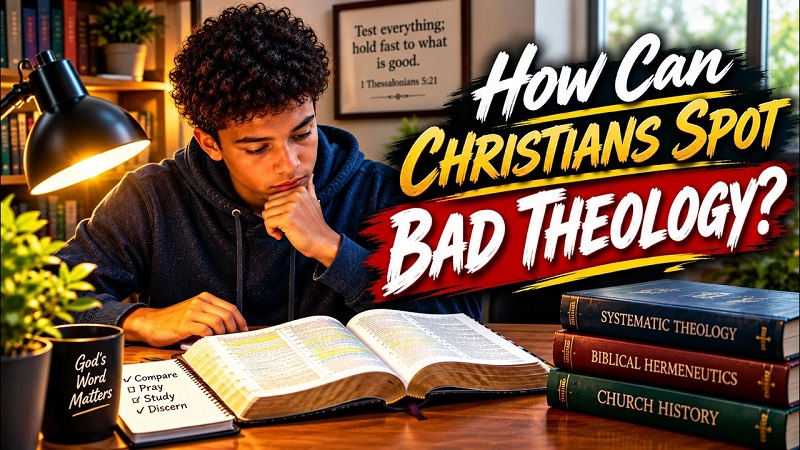
How Can Christians Spot Bad Theology?
6 Warning Signs
Not every teaching presented in the name of the Christian faith accurately reflects the Bible. Some theologies are built on human assumptions, selective interpretation, denominational traditions, or misunderstandings of Scripture. These can lead believers away from biblical truth and create confusion, division, and spiritual imbalance.
So, how can Christians recognize bad theology?
By examining how a theology interprets Scripture, handles evidence, responds to correction, and reflects the message of Jesus Christ, we can identify warning signs that may indicate its conclusions are unreliable. Here are six important things to watch for.
1. The Theology Is Designed to Defend a Particular School of Thought
A theological school of thought influences how people approach Scripture, interpret biblical passages, and develop doctrinal conclusions.
For example, Christians from different theological traditions may emphasize God’s sovereignty, human responsibility, grace, faith, predestination, or free will in different ways. Their interpretive frameworks can influence which passages they emphasize and how they understand other Scriptures.
The problem arises when a theological system becomes more important than the pursuit of biblical truth.
When someone is committed to defending a particular school of thought at all costs, they may dismiss passages that challenge their position, reinterpret difficult Scriptures to fit their framework, or reject evidence that could require them to reconsider their beliefs.
Christians should not blindly follow a theological system simply because it is associated with a respected teacher, denomination, institution, or tradition.
Jesus promised that the Holy Spirit would guide His disciples into truth (John 16:13). We should therefore seek God’s guidance while examining teachings carefully through Scripture.
A theology should help us understand the Bible, not dictate what the Bible is allowed to say.
2. The Theology Begins With an Assumption and Searches for Verses to Support It
Assumptions, hypotheses, and theories can be useful starting points for investigation. The problem is not having an initial idea; the problem is refusing to reconsider it when the evidence challenges it.
Some people approach the Bible with a conclusion already established in their minds. Instead of investigating what Scripture teaches, they search for verses that appear to support their position.
This approach is often called confirmation bias: a tendency to favor evidence that supports our existing beliefs while ignoring or minimizing evidence that challenges them.
For example, someone may become convinced of a particular doctrine and then interpret every relevant passage in a way that reinforces that belief. When confronted with Scripture that appears contradictory, they may dismiss it, explain it away, or accuse others of misunderstanding it without genuinely examining the passage and providing evidence.
Reliable theological research requires intellectual honesty, humility, and a willingness to change our conclusions when the evidence warrants it.
We should constantly test our theories and presuppositions rather than treating our assumptions as unquestionable truths.
3. The Theology Relies on Selected Scriptures Rather Than the Whole Bible
One of the most common problems in biblical interpretation is building doctrines from selected verses without examining the entire biblical message.
This can happen in discussions about marriage, giving, tithing, prosperity, healing, spiritual gifts, church leadership, salvation, the nature of God, and many other subjects.
A verse may be quoted accurately but applied incorrectly because its context, audience, purpose, or relationship to other Scriptures has been ignored.
For example, a teaching about financial giving may emphasize promises of blessing while neglecting passages that address generosity, contentment, sacrificial giving, and the dangers of loving money.
Likewise, discussions about God’s sovereignty and human responsibility can become unbalanced when believers emphasize some biblical passages while neglecting others.
We should not casually dismiss God’s sovereignty, nor should we ignore the biblical responsibility of human beings to respond to God. These subjects require careful examination of the full biblical message rather than relying on a few selected passages.
The same principle applies to other doctrines.
A reliable theology must consider relevant Scriptures together, respect their contexts, and allow the Bible to interpret itself as much as possible.
If a doctrine depends on ignoring significant portions of Scripture, it deserves careful examination.
4. The Theology Elevates Human Traditions Above God’s Word
Christian traditions, customs, and cultural expressions are not inherently wrong. Different communities may worship, organize, and serve in different ways while remaining faithful to Christ.
The problem arises when human traditions and patterns are treated as divine commands or when people assume their customs are more biblical simply because they are familiar.
Jesus warned against allowing human traditions to invalidate God’s Word (Mark 7:6–13).
Throughout Christian history, cultural backgrounds, geographical locations, denominational identities, and traditions have influenced how believers practice their faith. These differences can be harmless or beneficial, but they become problematic when they contradict biblical teaching or create unnecessary barriers between Christians.
For example, a church may insist that a particular style of worship, dress, ceremony, or organizational structure is the only acceptable Christian practice even when Scripture does not establish such a requirement.
We must distinguish between what God commands, what Scripture permits, and what people have developed as cultural or religious traditions.
Our loyalty should ultimately be to Christ and His Word, not to customs that cannot withstand biblical examination.
5. The Theology Fails to Distinguish Between the Old and New Covenants
The Bible contains both the Old and New Covenants, and understanding their relationship is essential for accurate interpretation.
The Old Testament provides the foundation for understanding God’s dealings with humanity, His promises, His law, His covenant with Israel, and the anticipation of the Messiah.
The New Testament reveals the fulfillment of God’s redemptive plan through Jesus Christ and explains the significance of His death, resurrection, and the New Covenant.
Hebrews 8:6–13 discusses the superiority of the New Covenant and explains the transition from the former covenant. Jesus is the mediator of a better covenant established on better promises.
However, this does not mean the Old Testament is useless or should be disregarded. Scripture remains valuable for teaching, correction, instruction, and understanding God’s purposes (2 Timothy 3:16–17).
The challenge is to understand which instructions belonged specifically to Israel under the Mosaic Covenant, how they functioned within that covenant, and how the New Testament explains their relationship to Christians.
For example, Christians should not simply take an Old Testament command concerning ceremonial practices, sacrifices, or covenant obligations and apply it directly without considering its fulfillment and context.
Failing to distinguish the covenants can result in confusion about Christian doctrine and practice.
A reliable theology recognizes the continuity of God’s redemptive plan while also respecting the distinctions Scripture makes between the covenants.
6. The Theology Fails to Center on Jesus Christ
Jesus Christ is central to God’s redemptive plan and the message of the Bible.
Jesus Himself explained that the Scriptures testify about Him (John 5:39). Following His resurrection, He showed His disciples how the Scriptures pointed to His suffering, resurrection, and the proclamation of repentance and forgiveness (Luke 24:27, 44–47).
Therefore, theology should help us understand Christ, His mission, His teachings, His death, His resurrection, and the implications of following Him.
A theology that focuses primarily on wealth, status, worldly success, power, or personal ambition while neglecting Christ and the gospel is spiritually unbalanced.
The Christian faith is not ultimately about pursuing earthly advantages. It is about reconciliation with God through Christ, becoming His disciples, living in obedience to His Word, loving others, and proclaiming the gospel.
Paul emphasized that his central message was Jesus Christ and Him crucified (1 Corinthians 2:2).
This does not mean every theological subject must directly discuss the crucifixion in every paragraph. Rather, our theological understanding as a whole should remain consistent with the gospel and the purposes of Christ.
Any theology that consistently distorts the character of Christ, undermines the gospel, or encourages believers away from His teachings deserves serious scrutiny.
How to Evaluate a Theology Before Accepting It
When you encounter a teaching, theological system, sermon, or doctrinal claim, ask yourself:
- Does it faithfully interpret Scripture within its context?
- Does it consider the broader biblical message or rely on selected verses?
- Is it willing to examine evidence that challenges its conclusions?
- Does it distinguish biblical commands from human traditions?
- Does it properly account for the relationship between the Old and New Covenants?
- Does it reflect the teachings, character, and gospel of Jesus Christ?
- Does it encourage humility, love, obedience, and spiritual maturity?
These questions can help you identify weaknesses without automatically condemning everyone who holds a different interpretation.
Christians should examine teachings carefully while treating fellow believers with humility, patience, and love.
Conclusion
Bad theology is not always easy to recognize. Sometimes it appears convincing because it uses biblical language, quotes Scripture, or is promoted by respected leaders.
However, we must remember that a teaching’s popularity, tradition, or theological label does not automatically make it biblical.
We should examine the assumptions behind it, the way it handles Scripture, its dependence on selected passages, its relationship to human traditions, its understanding of the covenants, and its focus on Jesus Christ.
The ultimate standard is not a theological school, denominational identity, or human authority. It is God’s Word.
Do not merely ask whether a theology supports your beliefs. Ask whether your beliefs faithfully reflect the Bible.
Share this message with anyone who is trying to understand the relationship between the Bible and theology.
Delve into study, research, and meditation on the Word, increase in wisdom, and remain blessed in the Lord!
Related Articles
- What Is Theology?
- Can Theology Contradict the Bible?
- Why Do Christians Have Conflicting Theologies?
- How Does Theology Differ from the Bible?
- What Makes Biblical Interpretation Reliable? Part 1
- What Makes Biblical Interpretation Reliable? Part 2
- Does Theology Replace the Bible?