
How Can Christians Spot Bad Theology?

Besides misunderstanding the role and purpose of theology, many Christians struggle to distinguish between the Bible and theology. As a result, it becomes difficult to recognize when a theology is undermining the faith. Let’s examine six approaches to spotting weak theologies that might jeopardize the faith of believers in various ways.


The Theology is Crafted to Defend a School of Thought

To keep it simple, a school of thought is the engine of every theology. It influences the way theology handles the Scriptures and shapes how a person or group interprets the Bible and develops doctrinal conclusions. Each worldview has its own school of thought that allows it to interpret the Bible. For example, Calvinists interpret the Bible believing that God exercises His absolute sovereignty through His grace rather than free will. Armenians believe that humans possess free will and can choose to accept or reject God. These two groups never reach a consensus. Other Christian groups approach the Bible with the perspective that Jesus is not God, or is simply a prophet or an ordinary human being. Others deny the trinity, opting for their preferred theory and reading the Bible through their unique lens. For anyone wanting an accurate interpretation of Scriptures, the sole guidance to depend on is the Holy Spirit. The Bible depicts Him as the sole guide to all truths (John 16:13).
The Theology Begins with an Assumption then Looks for Verses to Validate it

Assuming things or forming suggestions and theories in life is perfectly fine as long as we conduct sincere research. The sole purpose of assuming something or creating a theory should be to conduct research aimed at uncovering the truth. The research findings have the potential to validate or invalidate your thought. Here is where the difficulty usually occurs, since many engage in research to validate their theory or assumption at any cost, despite insufficient evidence. The appropriate response upon assuming something is to carry out sincere scientific investigation and concede when evidence is insufficient. Individuals who consider their viewpoint infallible and avoid critical evaluation are entirely mistaken. They are often the ones who create problematic theologies with contradictory interpretations of the Bible.


The Theology Relies on Selected Scriptures, not on the Entire Bible

A major issue in Bible interpretation within the Body of Christ today is depending on selected Scriptures to construct theologies for Bible doctrines. This is evident in various areas like marriage, tithing, sowing financial seeds, prosperity, healing, women ordained to lead men, the trinity, and more. Many randomly select Bible verses from both covenants, neglect to interpret them within their context, and construct theologies that inadequately explain the doctrines they aim to clarify. A lot of imbalances arise from this, as many prioritize their own desires and go their separate ways, neglecting the Bible’s calls for unity.

A major reason Calvinism and Arminianism will never agree is their reliance on selected Scriptures. We must not casually dismiss God’s sovereignty, nor assume that God created us as robots with no ability to make decisions. God’s sovereignty and free will operate side by side, a mystery we struggle to clarify. But He made things that way to ensure we remain humble. We can conduct a similar analysis for all the other aforementioned areas of misinterpretation. Christians who base their theologies on selected Scriptures seldom let the Bible interpret itself, unless it supports their preconceived beliefs.


The Theology Wants to Maintain Certain Christian Traditions

There is nothing wrong with having unique Christian customs and approaches to worship and service. God structured the Christian faith to ensure His gifts to us manifest in a variety of ways. Nevertheless, we need to be cautious in differentiating human traditions from God’s doctrines. Many Christians perceive their denominational loyalty through a traditional lens, believing it to be more scriptural than other denominations. The question emerges whether God is responsible for creating denominations with conflicting doctrines. Clearly, our different geographical locations and cultural backgrounds will lead to varied forms of worship and service. Nonetheless, these human and geographical diversities should not conflict with God’s doctrines. It is alarming when people mix cultural, geographical, and traditional alienations with the doctrines of the Bible. These kinds of actions always cause confusion since people focus more on their traditions and human patterns than on the Word of God. A major issue with such tendencies is that they result in extreme religiosity.


The Theology Doesn’t Distinguish Between the Old and New Covenants

We briefly mentioned this earlier by noting that the Bible has two covenants, and a Christian who fails to differentiate between them will face limitations in their spiritual journey. The Word of God in the Old Testament paves the way for us to understand the New. To genuinely understand the New Testament, we must first carefully analyze the Old. Although the Old Testament is considered obsolete, it is presented as a copy or subordinate version of the New, with many principles and doctrines repeated within the New. Undoubtedly, the New Testament can be confirmed as having a much greater standard than the Old. Not differentiating between the Old and New Covenants when interpreting the Bible inevitably results in misunderstanding and misinterpretation.


The Theology Doesn’t Point to Christ and Him Crucified

Theology that doesn’t center on glorifying Christ is pointless. Throughout the Bible, from Genesis through Revelation, there is a unique message that directs attention to Christ. Our theologies should concentrate on research efforts that improve our understanding of that message. When theology emphasizes wealth and worldly achievements without Christ directing it for His purposes, it becomes nonsense. We are here on earth with one mission: to know God through Christ, by the Holy Spirit’s help, and to lead a holy life in obedience to His Word by carrying out His will. Hence, we can look forward to living forever with Him at His return, since we are merely temporary in this fading and corrupt world that holds no hope for the lost. Anything that doesn’t follow this line of thought is a waste of time on earth.

Don’t forget to share this message with anyone grappling with the relationship between the Bible and theology.

Delve into study, research, and meditation on the Word, increase in wisdom, and remain blessed in the Lord!
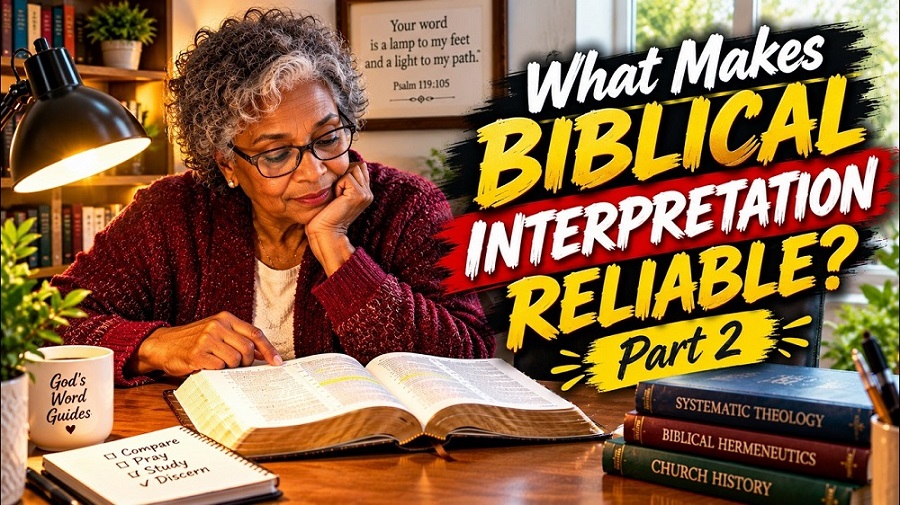
 

What Makes Biblical Interpretation Reliable? Part 2

In Part 1, we talked about the Holy Spirit, Logos, Rhemas, and context. Let’s move forward with the other essential interpretation protocols to keep in mind.


Prayer

When you depend on the Holy Spirit to interpret Scripture, you establish a foundation for consistently reaching the truth. Once you can tell the difference between interpreting the Bible to understand its message and doing so to generate Rhemas from the Logos, you have laid the key groundwork needed for interpreting Scripture. The other tools that follow are designed to help you finetune everything, with the initial one being prayer. You cannot learn about God without having a communication protocol with Him. Not only does God insist on prayer, but it also enables Him to act upon our obedience to His promises, eliminating every obstacle from the dark world that hinders our understanding of the truth. A researcher without prayer depends solely on reason, which alone is too feeble to engage and prevail in the spirit realm.


Linguistic and Cultural Challenges

When we read the Bible and its stories, some communication patterns might not be immediately clear unless we examine the culture and language of the era when that passage was written. It’s unclear what the expression “a camel going through the eye of a needle” signifies. That was something recognized by those living at the time. Additional examples include city names that have vanished over time or been changed to entirely different ones because of the progression of civilization. Sometimes, we have to revisit and study those ancient periods to grasp the meaning of those things in their original context. It’s only then that we can genuinely interpret what the writers meant in today’s context.


Translation Challenges

Translating certain Bible passages from one language to another is quite difficult, particularly when we lack sufficient understanding of the culture and context in which the author wrote. Occasionally, the Hebrew, Aramaic, and Greek languages contain idioms and ancient phrases that are entirely lost or whose meanings are scarcely understood nowadays. The situation worsens when the language we are translating into lacks an equivalent word or phrase. Therefore, it is essential to consistently consult the copies of the original Greek, Hebrew, and Aramaic manuscripts when studying the Bible to get as close as possible to the original meaning intended by the author. We know that the Holy Spirit always fills the knowledge gaps during research to help us grasp what the authors intended.


What Jesus Does and Says

The entire Bible points to Jesus. His primary purpose is to reveal the Father and guide us to know Him by relying on the Holy Spirit’s assistance. While not disregarding the literal meanings of the stories and passages throughout the entire Bible from Genesis to Revelation, we must always remember that God’s primary purpose in inspiring humans to compile the written Bible is to understand Jesus’ mission on earth. Any interpretation that ignores this central understanding deviates from genuine wisdom. Thus, Jesus is at the heart of both the Old and New Testaments. The Old Testament looks forward to Him and the New Testament looks back on His finished work on the cross. Consequently, everything Jesus says and does regarding the new Kingdom life sets the standard for how we should live our Christian lives on earth.


What the Apostles and Early Christians Do and Say

Given all biblical evidence points to Jesus, it was the apostles and Early Christians who first inherited the heavenly Christian traditions taught by Jesus and were the pioneers in practicing them in this world. Therefore, all their words, actions, behaviors, attitudes, and life approaches deserve careful study to guide us in this church age. This is why the Book of Acts and the apostles’ letters to the churches exist—to bring a historical understanding and offer crucial direction for Christians today.


When interpreting the Bible, one should consider all these additional factors.

Share this information along to members of your community who find the connection between the Bible and theology challenging.

Learn, explore, acquire knowledge, and stay blessed in the Lord!


Does Theology Replace The Bible?

Many spiritual leaders today promote their schools of thought from the pulpit and establish theological institutions to teach their own Christian traditions to adherents. This has resulted in the widespread emergence of numerous Christian worldviews, denominations, and diverse movements, often with conflicting fundamental doctrines. This freedom directly leads to confusion, intellectual pride, and disunity among different Christian factions. However, the question arises whether Christians ought to focus on their theological schools of thought on pulpits, potentially overshadowing God’s Word.

To effectively answer this question, we need to examine three key aspects of theology: its definition, its role, and its purpose.


What is Theology?

To gain a better understanding, the reader should consult the article and the video titled “What is Theology?” Essentially, theology is our method for seeking and reasoning about God, His Word, and His divine plan for humanity, involving the organization of information and the collection of evidence to deepen our understanding of Him. This definition reveals theology as a mere instrument for investigating God and His intentions for humanity.


What’s Theology’s Role?

From its definition, we can readily observe a key role of theology. It enables us to collect evidence from the Bible, the world, and the universe, thereby illuminating biblical doctrines and premises. For example, a skeptic might request proof of Jesus Christ’s existence and crucifixion. How can we demonstrate this to be true? In Christology, abundant historical data exists on Jesus, sourced from both Christian and non-Christian accounts, which unequivocally detail His life. Furthermore, most places where Jesus preached the gospel have been identified. We could conduct a similar study to establish the existence of Jericho and the authenticity of the story of its walls and Rahab.


Theology’s second function is to organize data that supports biblical assertions. While collecting spiritual resources or evidence is beneficial, categorizing them is even more remarkable. Be aware that the Christian faith faces criticism from multiple sources. Muslims, Buddhists, cults, occultists, evolutionists, atheists, pagans, traditionalists, and others attack Christians. These different belief systems require distinct strategies and evidential apologetics to challenge their assertions and guide them toward the truth. Our approach to challenging evolutionists will differ from our approach to responding to Muslims. Organizing information is therefore crucial for research and study, enabling quick and sure responses to individuals attempting to disprove the Christian faith.


What’s Theology’s Purpose?

By considering the definition and purpose of theology, we find that its foremost role is to enhance our comprehension of the Father whom we serve and honor. By researching and organizing biblical information and evidence from across the universe that backs biblical claims, we deepen our knowledge of the Father and His will.


A second aim of theology is to nurture our spiritual development, both personally and communally. Theology’s role in gathering and structuring spiritual resources leads to greater insight into God, personal spiritual development, and the ability to pass this knowledge on to posterity.


At last, we are highly effective at spreading the gospel and bringing people into God’s kingdom. This statement holds true, as we can readily consult various theological fields of study for specific answers to address questions from those who challenge the Christian faith. Globally, the Christian apologetic sphere stands out as the most developed and systematic, equipped with resources and responses for any movement that has targeted Christians. This extensive collection of knowledge and resources grows daily, with more evidence supporting the Christian faith.


Answer

Considering theology’s meaning, role, and purpose, we can assert that it should never supplant the Bible. The Bible is unique as the sole source of God’s Word, while theology serves as a research method or tool to illuminate biblical information.


Pass the material on to those in your cycle who find the Bible-Theology relationship challenging.


Keep learning, researching, gaining wisdom, and stay blessed in the Lord!