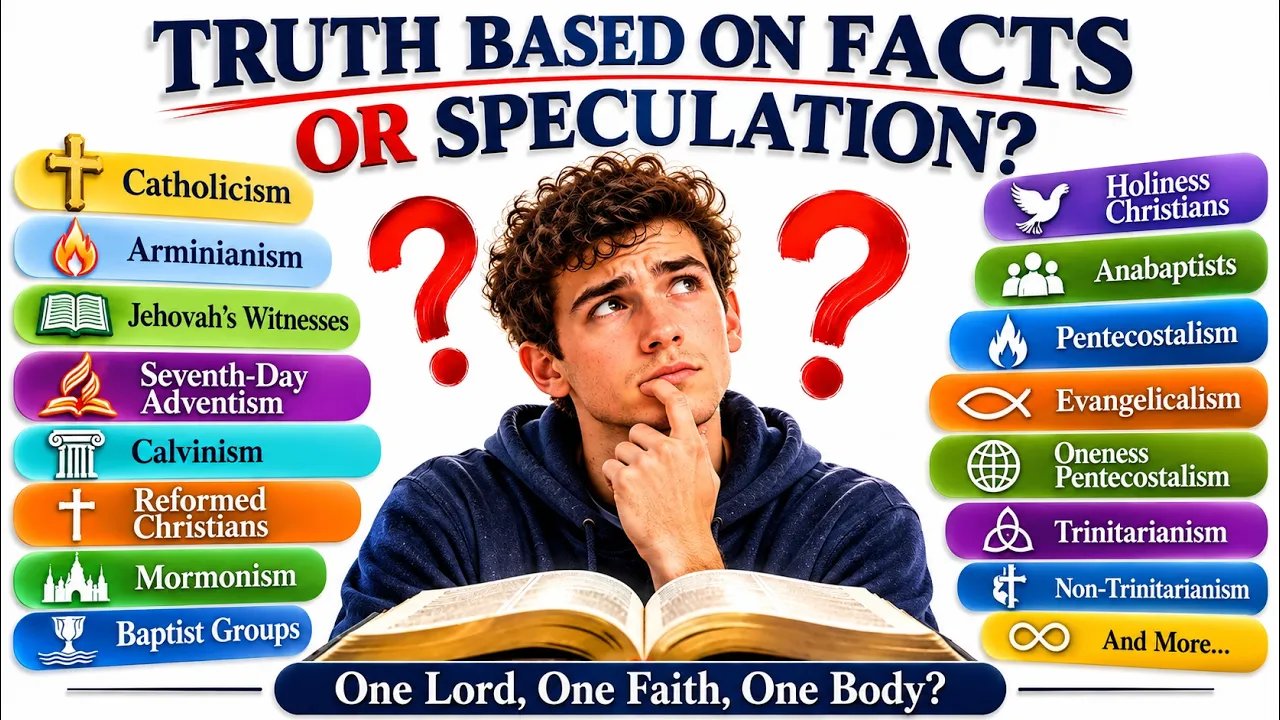
Is God the Author of All Christian Worldviews and Theological Camps?
The Christian world contains numerous worldviews, theological systems, and denominations. From Calvinism and Arminianism to Catholicism, Pentecostalism, and many others, Christians often find themselves separated into different camps. This raises an important question: Is God the Author of all these Christian worldviews and theological camps?
To answer this question, we must first understand what a worldview is, what a denomination is, and what the Bible teaches about unity and diversity within the Body of Christ.
Worldviews and Denominations
A denomination is a distinct religious group that shares a general faith but has its own beliefs, practices, or organizational structure (Wikipedia). Examples include Catholics, Baptists, Anglicans, Presbyterians, Lutherans, Methodists, Adventists, and many others.
A worldview is the fundamental cognitive lens, framework, or set of beliefs through which an individual, group, or society interprets reality, makes sense of life, and guides their actions (truthstory.org).
Within the Christian faith, there are many worldviews and theological schools of thought, including Calvinism, Preterist, Jehovah’s Witnesses, Mormonism, Arminianism, Protestantism, Orthodoxy, Pentecostalism, Evangelicalism, Trinitarianism, Non-Trinitarianism, Fundamentalism, and more.
Unity and Diversity
The Bible presents a clear relationship between unity and diversity. A people or group are united when they have the same doctrines, laws, regulations, principles, and interpret them the same way. Christians are united when they understand and interpret God’s doctrines (the Bible) in the same way.
People in a united community exercise their gifts and talents in different or diverse ways. Diversity, therefore, relates to gifts, talents, and competences. People serve differently because the Holy Spirit gives different gifts to different individuals.
In 1 Corinthians 12, Paul speaks of “diversities of gifts,” “diversities of ministries,” and “diversities of activities.” Yet there is still the same Spirit, the same Lord, and the same God. The diversity is found in the types of giftings, ministries, and activities, not in interpretation of the Logos.
God’s design for the Church is therefore a community that is united in regulations, rules, doctrines, and principles, but diverse in gifts, talents, competencies, and service.
So, Is God the Author of All Christian Worldviews and Theological Camps?
When we examine the many Christian worldviews and denominations around us, one fact becomes difficult to ignore. They do not all believe the same things. They do not all interpret doctrine the same way. They do not all move in the same direction.
Many hold conflicting and even contradictory positions. Some trust authorities or writings that compete with Scripture itself. The result is a landscape of competing interpretations, theological disputes, and confusion among sincere seekers of truth.
This is not to say that the Christian faith lacks answers. Truth exists, and God guides His people through the Holy Spirit. However, the reality remains that the Christian world is divided by conflicting worldviews, denominational systems, and theological camps. For this reason, the answer to our question is no.
God is not the author of confusion. The conflicting and contradictory nature of many worldviews and theological camps points not to God’s design but to human ideologies, intellectual pride, and theological systems that have become entrenched in their own positions.
How Should Christians Move Forward?
First, Christians must remember that they are Christians before they are anything else. The Bible speaks of one body, one faith, one baptism, and one Lord Jesus Christ. (Ephesians 4:1-7). No denomination or worldview is greater than the Body of Christ itself.
Second, believers must rely on the Holy Spirit. Jesus promised that the Holy Spirit would guide His people to the truth (John 16:13). Christians should therefore seek His guidance above human labels, traditions, and theological camps.
Finally, believers should focus on growing in faith, wisdom, and knowledge of God’s Word while allowing the Holy Spirit to direct their lives. Although denominations and worldviews may be difficult to avoid entirely, they should never replace devotion to Christ or obedience to His Word.
Conclusion
The Bible presents a picture of a Church that is united in doctrines while diverse in gifts and ministries. Today’s conflicting worldviews and theological divisions fall short of that ideal. Therefore, God cannot be regarded as the Author of all Christian worldviews and theological camps.
Our ultimate loyalty must not be to a denomination, a theological system, or a religious label. It must be to Jesus Christ, His Word, and the guidance of the Holy Spirit. By keeping Christ at the centre, Christians can avoid confusion and sincerely grow in the faith wherever God wants them to be.
If you found this article helpful, consider sharing it with others in your community. Meaningful discussions about faith issues like this can encourage unity, enhance genuine research in the Body of Christ, and help believers grow in wisdom, faith, and spiritual maturity.
Stay Blessed in the Lord!