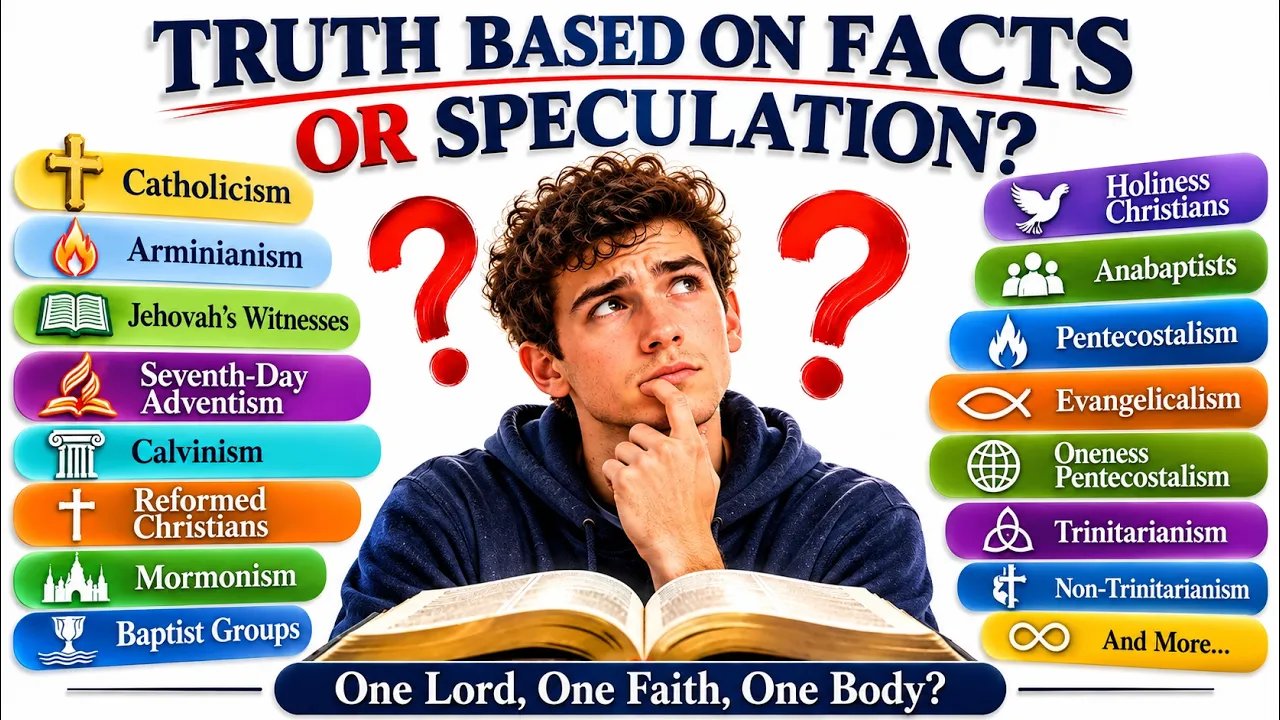
Is God the Author of All Christian Worldviews and Theological Camps?


The Christian world contains numerous worldviews, theological systems, and denominations. From Calvinism and Arminianism to Catholicism, Pentecostalism, and many others, Christians often find themselves separated into different camps. This raises an important question: Is God the Author of all these Christian worldviews and theological camps?


To answer this question, we must first understand what a worldview is, what a denomination is, and what the Bible teaches about unity and diversity within the Body of Christ.


Worldviews and Denominations


A denomination is a distinct religious group that shares a general faith but has its own beliefs, practices, or organizational structure (Wikipedia). Examples include Catholics, Baptists, Anglicans, Presbyterians, Lutherans, Methodists, Adventists, and many others.


A worldview is the fundamental cognitive lens, framework, or set of beliefs through which an individual, group, or society interprets reality, makes sense of life, and guides their actions (truthstory.org).


Within the Christian faith, there are many worldviews and theological schools of thought, including Calvinism, Preterist, Jehovah’s Witnesses, Mormonism, Arminianism, Protestantism, Orthodoxy, Pentecostalism, Evangelicalism, Trinitarianism, Non-Trinitarianism, Fundamentalism, and more.


Unity and Diversity


The Bible presents a clear relationship between unity and diversity. A people or group are united when they have the same doctrines, laws, regulations, principles, and interpret them the same way. Christians are united when they understand and interpret God’s doctrines (the Bible) in the same way.


People in a united community exercise their gifts and talents in different or diverse ways. Diversity, therefore, relates to gifts, talents, and competences. People serve differently because the Holy Spirit gives different gifts to different individuals.


In 1 Corinthians 12, Paul speaks of “diversities of gifts,” “diversities of ministries,” and “diversities of activities.” Yet there is still the same Spirit, the same Lord, and the same God. The diversity is found in the types of giftings, ministries, and activities, not in interpretation of the Logos.


God’s design for the Church is therefore a community that is united in regulations, rules, doctrines, and principles, but diverse in gifts, talents, competencies, and service.


So, Is God the Author of All Christian Worldviews and Theological Camps?


When we examine the many Christian worldviews and denominations around us, one fact becomes difficult to ignore. They do not all believe the same things. They do not all interpret doctrine the same way. They do not all move in the same direction.


Many hold conflicting and even contradictory positions. Some trust authorities or writings that compete with Scripture itself. The result is a landscape of competing interpretations, theological disputes, and confusion among sincere seekers of truth.


This is not to say that the Christian faith lacks answers. Truth exists, and God guides His people through the Holy Spirit. However, the reality remains that the Christian world is divided by conflicting worldviews, denominational systems, and theological camps. For this reason, the answer to our question is no.


God is not the author of confusion. The conflicting and contradictory nature of many worldviews and theological camps points not to God’s design but to human ideologies, intellectual pride, and theological systems that have become entrenched in their own positions.


How Should Christians Move Forward?


First, Christians must remember that they are Christians before they are anything else. The Bible speaks of one body, one faith, one baptism, and one Lord Jesus Christ. (Ephesians 4:1-7). No denomination or worldview is greater than the Body of Christ itself.


Second, believers must rely on the Holy Spirit. Jesus promised that the Holy Spirit would guide His people to the truth (John 16:13). Christians should therefore seek His guidance above human labels, traditions, and theological camps.


Finally, believers should focus on growing in faith, wisdom, and knowledge of God’s Word while allowing the Holy Spirit to direct their lives. Although denominations and worldviews may be difficult to avoid entirely, they should never replace devotion to Christ or obedience to His Word.


Conclusion


The Bible presents a picture of a Church that is united in doctrines while diverse in gifts and ministries. Today’s conflicting worldviews and theological divisions fall short of that ideal. Therefore, God cannot be regarded as the Author of all Christian worldviews and theological camps.


Our ultimate loyalty must not be to a denomination, a theological system, or a religious label. It must be to Jesus Christ, His Word, and the guidance of the Holy Spirit. By keeping Christ at the centre, Christians can avoid confusion and sincerely grow in the faith wherever God wants them to be.


If you found this article helpful, consider sharing it with others in your community. Meaningful discussions about faith issues like this can encourage unity, enhance genuine research in the Body of Christ, and help believers grow in wisdom, faith, and spiritual maturity.


Stay Blessed in the Lord!


How Should Christians Respond to Conflicting Theological Views?

Regrettably, the world of Christian worldviews and movements is fragmented, with little consensus on numerous theological issues. These disputes have caused many people to form their own groups based on their personal convictions and inspirations. The outcome is that genuine seekers of truth encounter conflicting ideologies, contradictory perspectives, and clear divisions that impede cooperative work and shared research. Article T0009 stated that genuine believers benefit more from identifying as Christians than from pursuing denominational ties. Because many of God’s children are affiliated with certain denominations, your chief goal must be to pursue God’s will wherever you are. To do God’s will within those conflicting denominational factions, we must dedicate ourselves to particular Christian values that ensure we stay fruitful. Here are four rules to help us rise above the unnecessary theological segregation.


Engage in Personal Bible Study

A lot of Christians have developed the habit of substituting the Word of God with their preferred preachers. They no longer want to engage in personal Bible study. However, God’s primary desire is to build a personal relationship with each of His children. While He uses gospel ministers to teach us His will and support our spiritual development, the underlying aim is for us to attain maturity and rely on Him personally for every spiritual and physical need. Since God identifies Himself as the Word (John 1:1), we should treat His Word in the Bible with utmost importance (Psalm 119:105, Psalm 119:37-38, Psalm 119:165).


Trust The Holy Spirit as Your Primary Teacher

We can read the Bible daily, yet we won’t grasp its meaning unless we seek the Holy Spirit’s guidance through meditation. The Bible depicts the Holy Spirit as the guide to all truths (John 16:13). It is not the place of any preacher or teacher to replace the Holy Spirit in the lives of their flock. Should we stop listening to our pastor, preachers, or inspired messages from other Christians? Absolutely not! But by doing so, we understand that they are vessels the Holy Spirit uses to support our spiritual development, discover God’s will, and practice an authentic Christian way of life.


Never Put Your Trust in Humans

It is understood that the word trust can be applied in a wider sense in our regular daily conversations. When we choose not to trust humans, we mean that we should first seek guidance from the Holy Spirit and God’s Word before believing anything from a human source. All gospel preachers around the globe should act as servants of God, not as substitutes for God in the lives of people. Their responsibility is to guide the flock to the Master. They support new converts until it is clear that they have brought them to a stage where self-reliance on God is possible, without acting as barriers to their progress. God doesn’t expect leaders to live the lives of their followers on their behalf. Similar to guiding a newborn from infancy through childhood to adulthood, seasoned Christians in the faith need to help new converts grow spiritually and allow them room to learn from God and follow His guidance themselves (Jeremiah 17:5-8).


If the Bile Doesn’t Say it, Don’t Believe it

It’s not merely a matter of faith but of properly handling the Word of truth. It is essential for all God’s children to do their best in acquiring basic Scripture interpretation skills and to trust the Holy Spirit to aid them in biblical interpretation. Whenever a preacher delivers the Word, we should embrace the Berean mindset and check if what the preacher says is accurate. The Bereans could sift through Paul’s teachings because they primarily trusted the Holy Spirit to guide their understanding of the Scriptures. If you adopt the Berean mentality, no one can trick, manipulate, cheat, exploit, or take advantage of you. In doing so, only God’s genuine revelations will flourish among us.


Furthermore, no individual is higher than the Bible. Are there spiritual matters beyond what the Bible covers? Without a doubt, the answer is yes. Is it our role to seek knowledge of these extra-biblical issues in today’s church era? Not necessarily, since the Holy Spirit gathered what is essential for this era in the Bible we possess. Many more mysteries are reserved for the future age, and when we reach that time, we will perceive things as they truly are. For the time being, we should appreciate what is available to us in the Bible. Moreover, truthfully, a lifetime isn’t sufficient to fully explore the present Bible, and the revelations we gather astonish many. Why should we stress over things we can’t completely understand right now?


By applying these principles in your life, you will readily recognize movements that depend on logical fallacies, those leaning towards religiosity, and those employing mind manipulation techniques to mislead people. Additionally, you will learn to differentiate falsehood from lies and trust the Holy Spirit to reveal an authentic way to accomplish God’s will in your context.

Share this message along to those in your community who wrestle with the connection between the Bible and theology.

Engage in study, conduct research, increase in wisdom, and be blessed in the Lord!